Skip to content
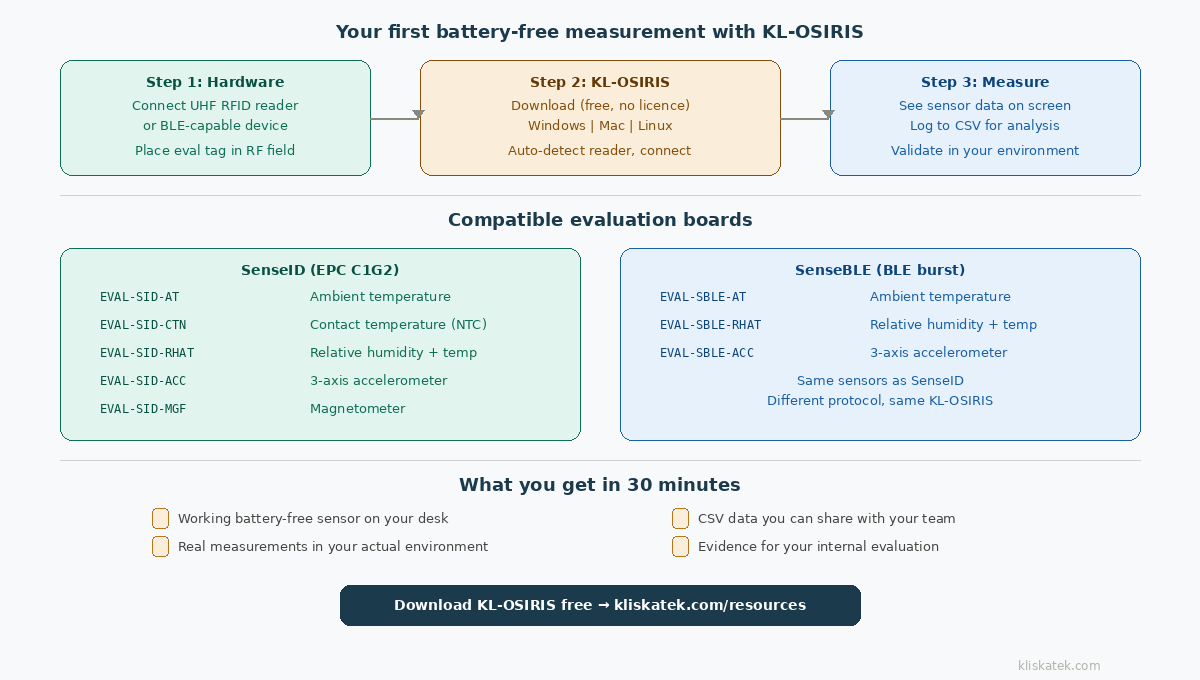
Three-step workflow for KL-OSIRIS — connect hardware, launch the software, take measurements — with a list of compatible SenseID and SenseBLE evaluation boards and a summary of what you get in 30 minutes.

Getting Started: Your First Battery‑Free Measurement with KL‑OSIRIS

Step-by-step guide to taking your first battery-free sensor measurement with KL-OSIRIS, Kliskatek’s free evaluation software. Connect a reader, place a tag, see live data in under 30 minutes.
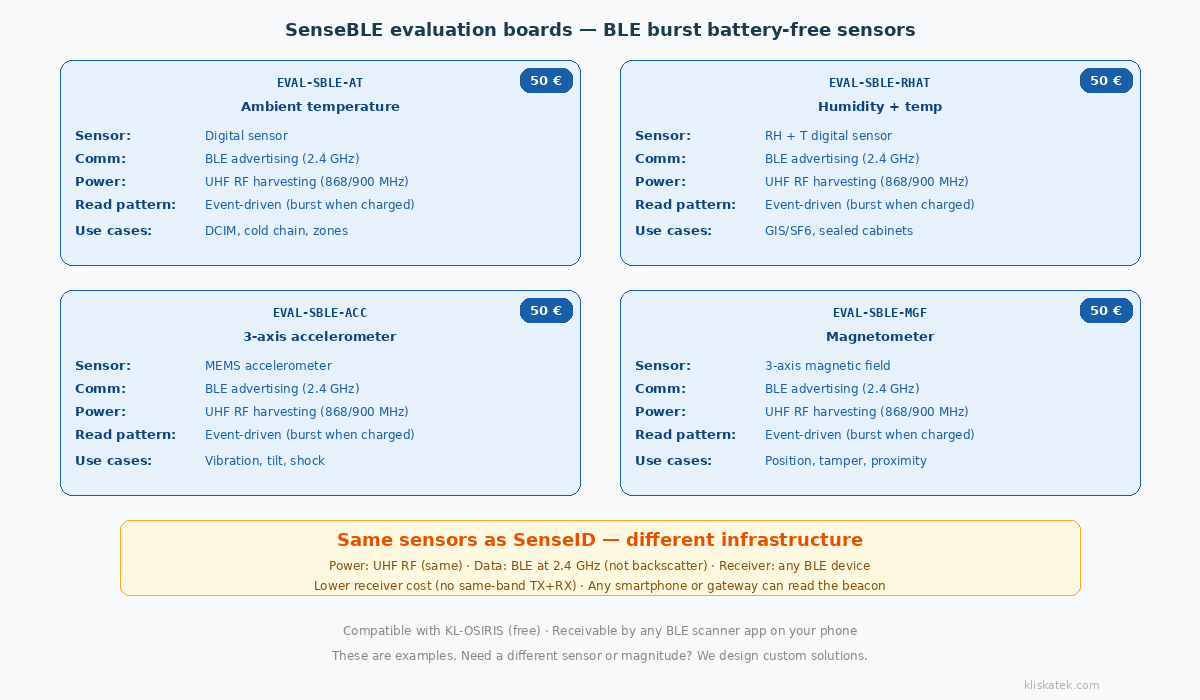
Four SenseBLE evaluation boards — EVAL-SBLE-AT (ambient temperature), EVAL-SBLE-RHAT (humidity and temperature), EVAL-SBLE-ACC (3-axis accelerometer), and EVAL-SBLE-MGF (magnetometer) — each at 50 euros, powered by UHF RF harvesting, communicating via BLE advertising bursts receivable by any BLE device.

SenseBLE Evaluation Guide: BLE Burst Tags — Same Sensors, Different Infrastructure

Complete guide to the SenseBLE evaluation boards. Four battery-free sensor tags that communicate via BLE advertising bursts — same sensors as SenseID, lower infrastructure cost. All at 50 € and readable by any BLE device.

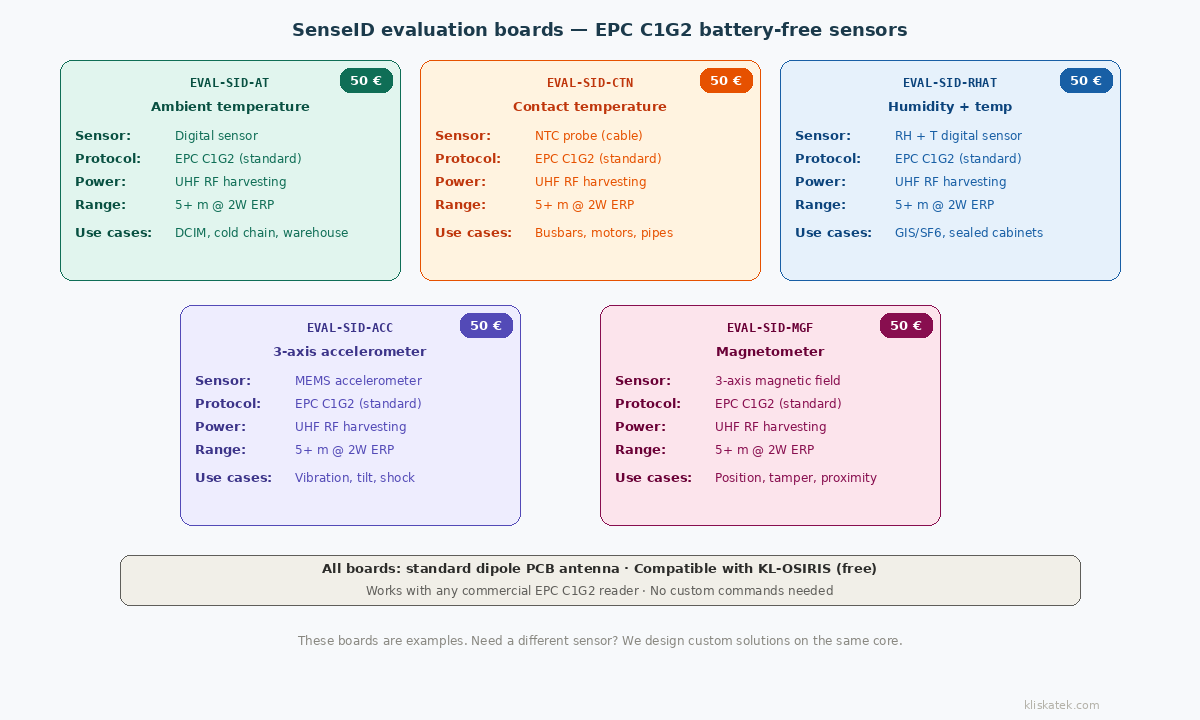
Five SenseID evaluation boards — EVAL-SID-AT (ambient temperature), EVAL-SID-CTN (contact temperature), EVAL-SID-RHAT (humidity and temperature), EVAL-SID-ACC (3-axis accelerometer), and EVAL-SID-MGF (magnetometer) — each at 50 euros, compatible with commercial EPC C1G2 readers and KL-OSIRIS software.

SenseID Evaluation Guide: EPC C1G2 Tags for Temperature, Humidity, Acceleration & More

Complete guide to the SenseID evaluation board family. Five battery-free sensor tags using EPC C1G2 — temperature, humidity, accelerometer, magnetometer and contact temperature — all at 50 € and compatible with commercial RFID readers.

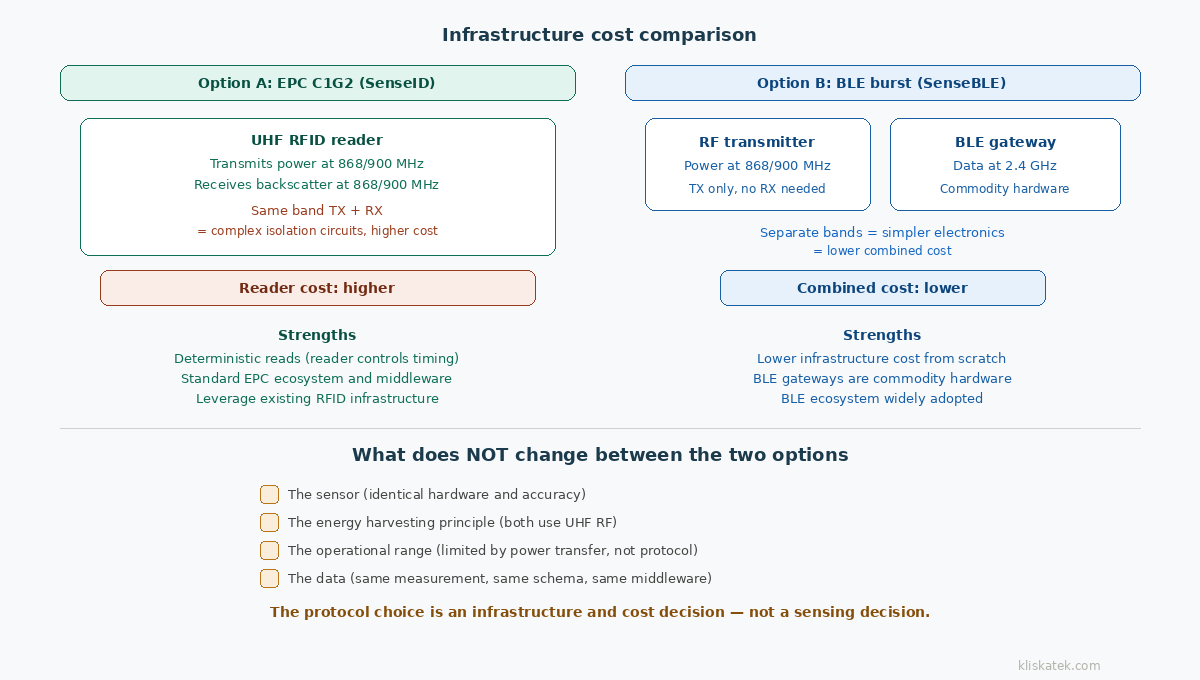
Side-by-side comparison showing EPC C1G2 path (single RFID reader with same-band TX and RX, higher cost) versus BLE burst path (separate RF transmitter and BLE gateway in different bands, lower combined cost), with a section showing what stays the same: sensor, accuracy, range, and data.

The Economics of Battery‑Free: RFID Reader Cost vs RF TX + BLE RX

Why UHF RFID readers cost more than RF transmitters plus BLE gateways, when each option makes economic sense, and how to think about total cost of ownership for battery-free sensor deployments.

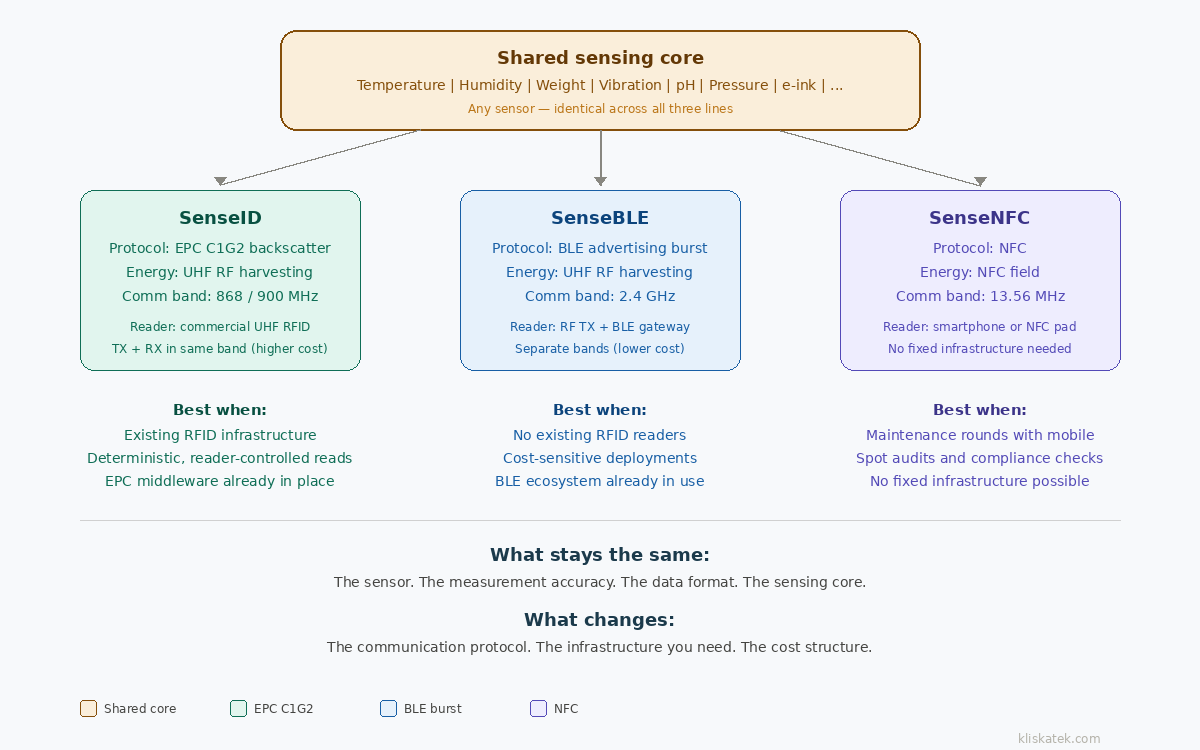
Diagram showing one shared sensing core at the top branching into three protocol paths — SenseID (EPC C1G2), SenseBLE (BLE burst) and SenseNFC (NFC) — each with different infrastructure requirements but identical sensing capabilities.

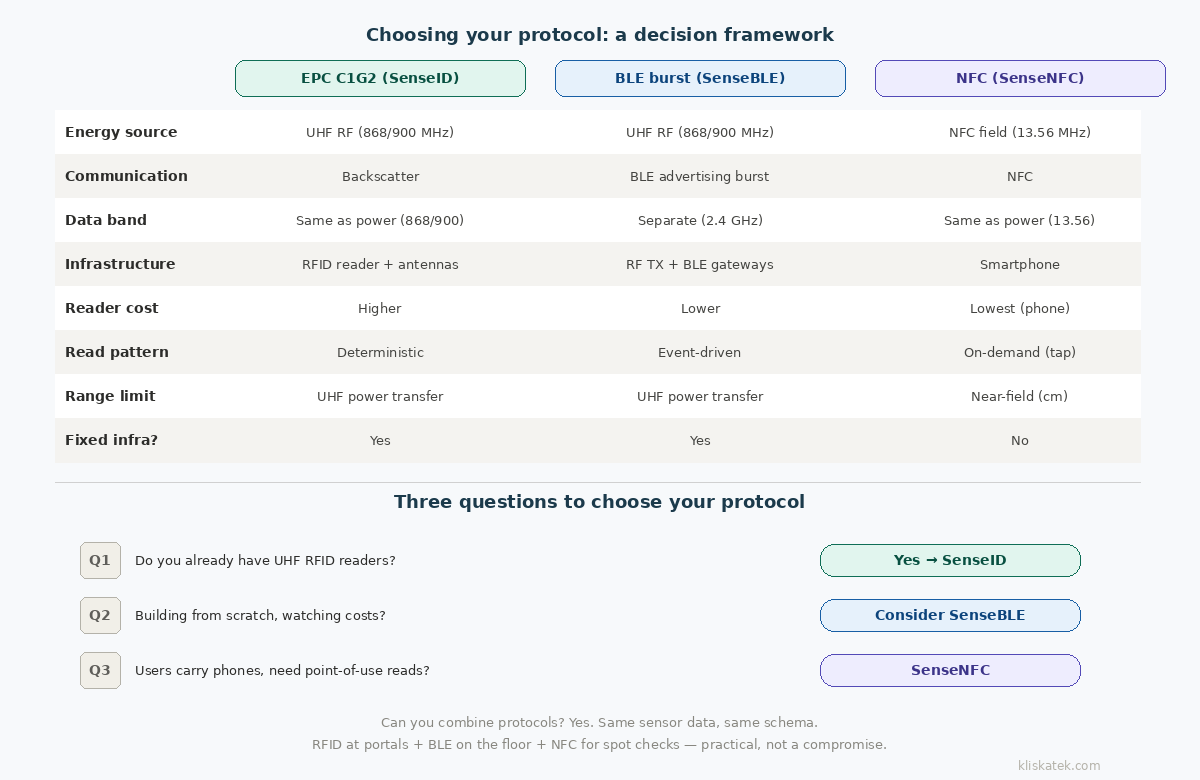
One Sensor, Three Protocols: How SenseID, SenseBLE and SenseNFC Share the Same Sensing Core

SenseID, SenseBLE and SenseNFC use the same battery-free sensors. The difference is the communication protocol and the infrastructure you need. Here’s how to choose.

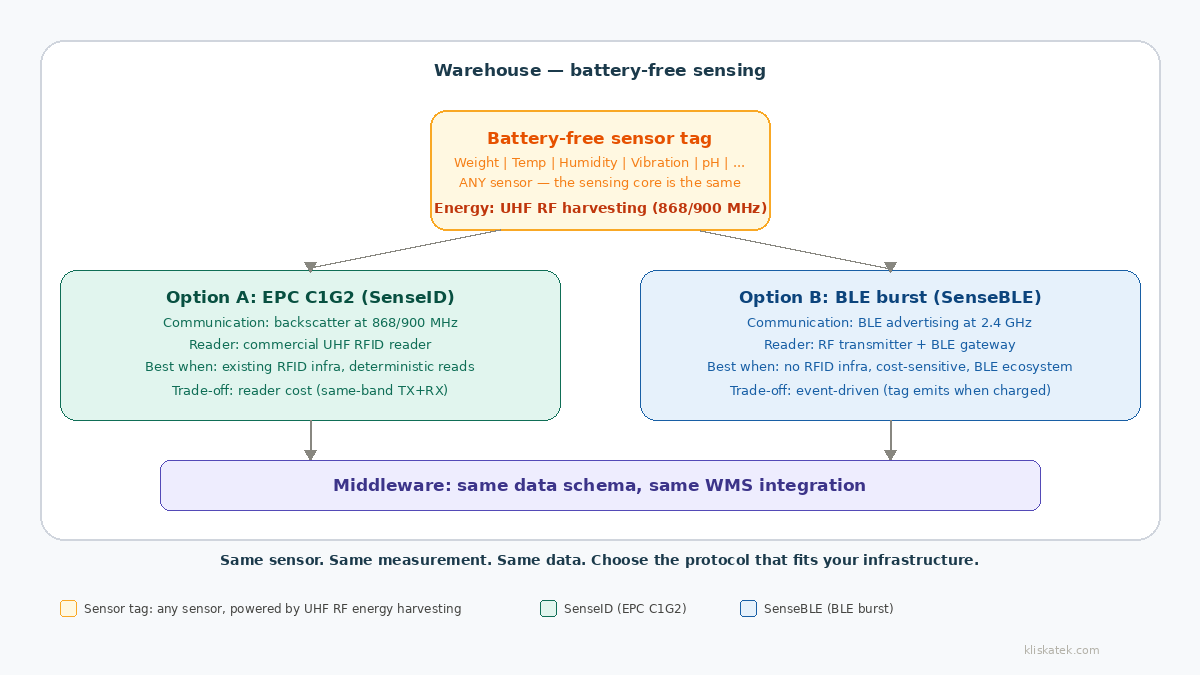
Warehouse floor with battery-free sensor tags on pallets, showing two communication options: EPC C1G2 via RFID reader or BLE burst via RF transmitter and BLE gateway — same sensors, different infrastructure.

Warehouse Sensing Without Batteries: Weight, ID & Environment with Any Protocol

Battery‑free sensors for warehouse weight, ID and environmental monitoring. Choose EPC C1G2 (SenseID) or BLE (SenseBLE) based on your infrastructure — the sensors are the same.